As I was preparing to become a father, I started thinking about what kind of first gift I could make. Not something entertaining or decorative. Something fundamental. Something to make sense of the world. A gift that doesn’t tell a child what to see, but helps them learn how to see. In the first years, everything still has to be discovered through experience, through touch, distance, difference. I wanted to make something that belongs to that beginning.
I've always been drawn to elementary forms of design. In 2014, my father invited me to visit the Elements of Architecture exhibition at the Venice Biennale. It stayed with me because of that time together, and because it was not about any single object. It raised a question that never really left: what are the fundamental elements of the space and the things around us?
Van der Laan
Dom Hans van der Laan (1904), a Dutch Benedictine monk, architect and designer, approached this question from a different angle. Where many design theories begin with geometry, he began with human perception. He observed that the world presents itself to us as a continuous field of sizes. Nothing is exactly equal, nothing is perfectly repeatable. Yet we are still able to understand it. Not because we measure everything precisely, but because we group things. We recognize similarities. We distinguish differences. We create order in what would otherwise be an infinite continuum.
Systems like the Golden Ratio describe relationships between sizes with clarity and elegance. But they work in two dimensions, relating lengths and widths. Van der Laan was interested in a different question: how we perceive and organise volumes, the three-dimensional reality we actually inhabit. He developed a system rooted in that experience. He called it the Plastic Number.
Before we can understand the world, we must first encounter it. Through touch. Through weight. Through proximity and distance. Through the relation between one thing and another. Understanding does not begin with abstraction, but with experience.
“Nothing is in the intellect which is not first in the senses.”
nihil est in intellect quod non sit prius in sensu
— Scholastic principle, as cited by Richard Padovan
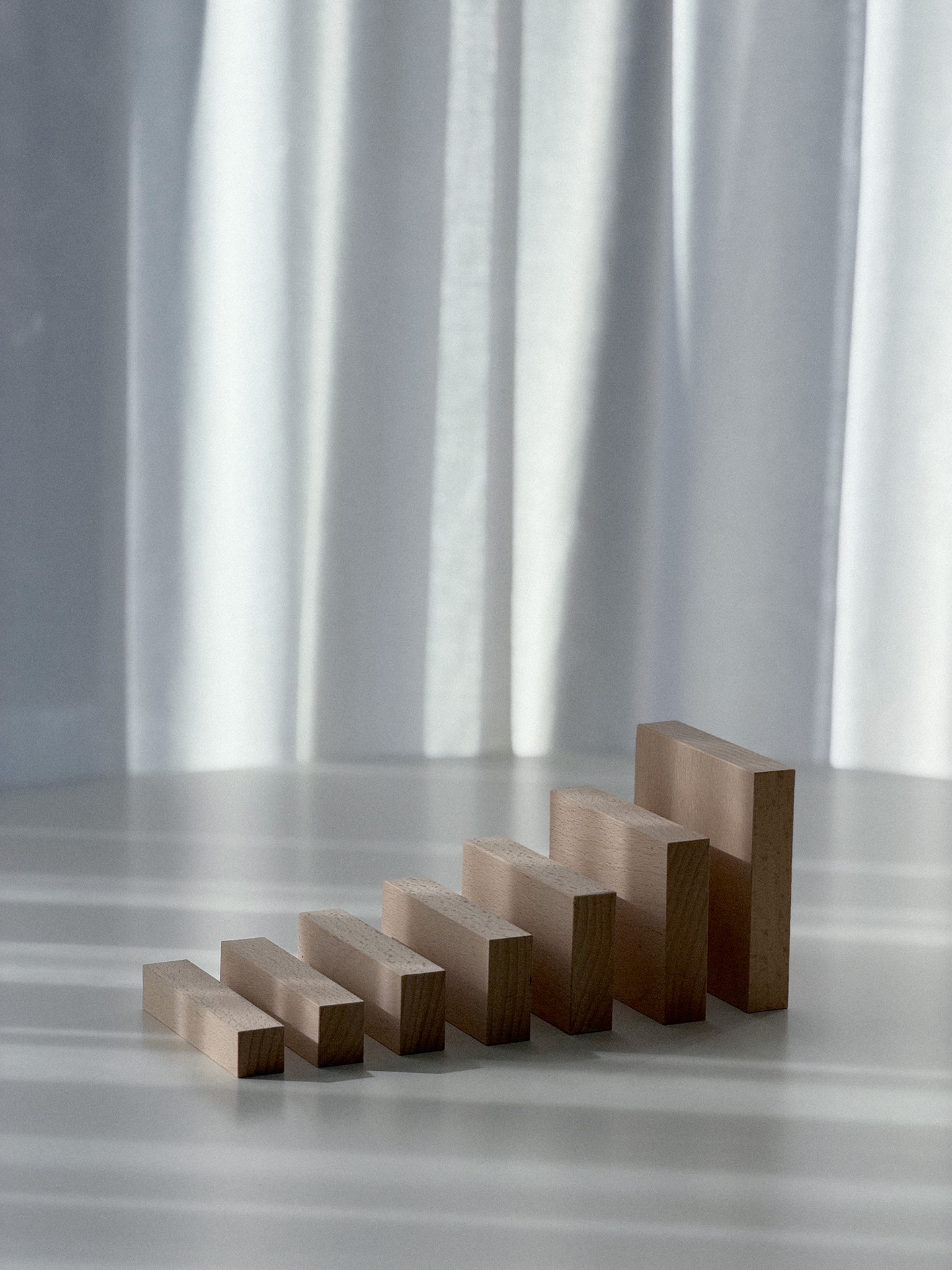
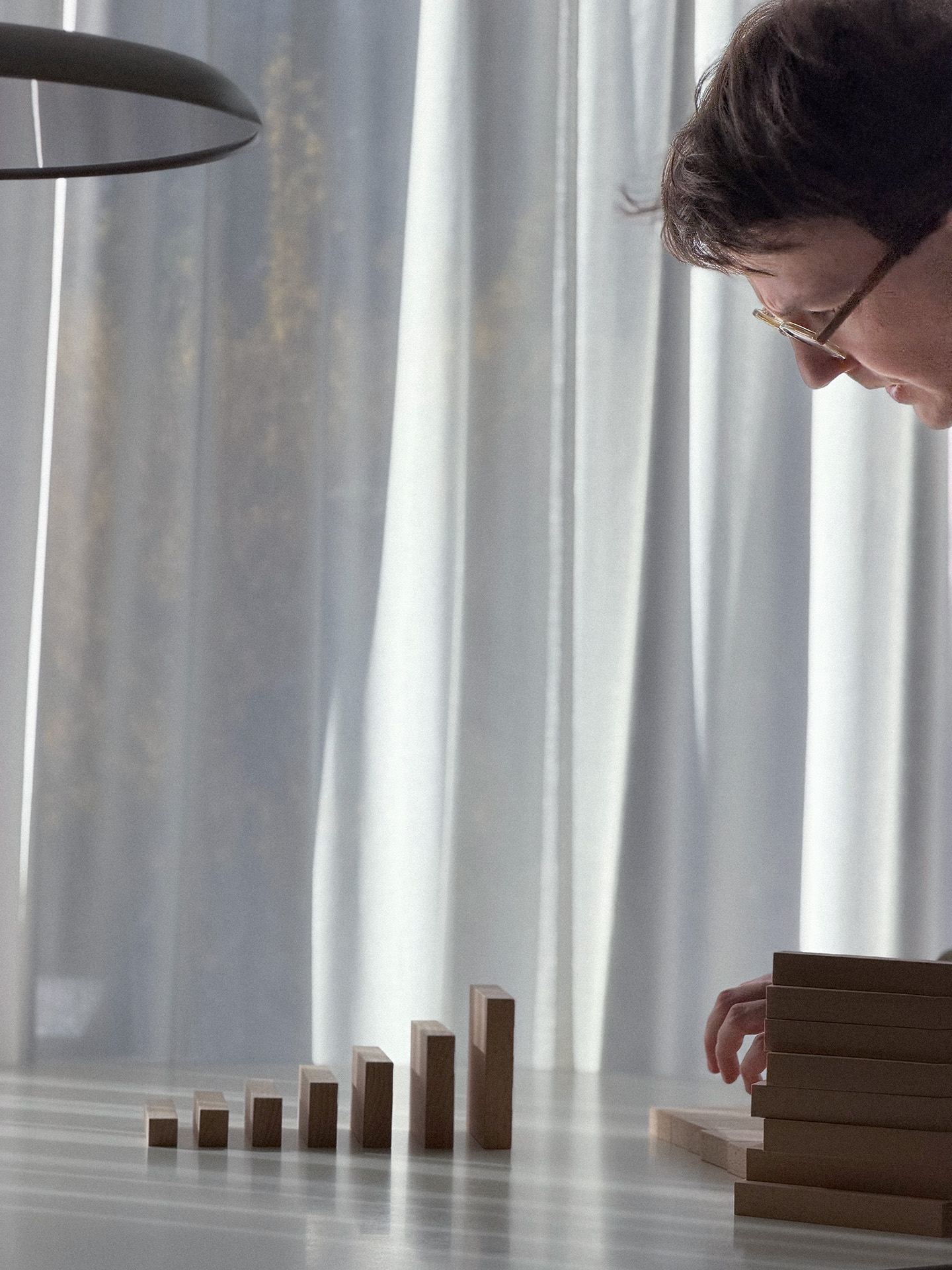
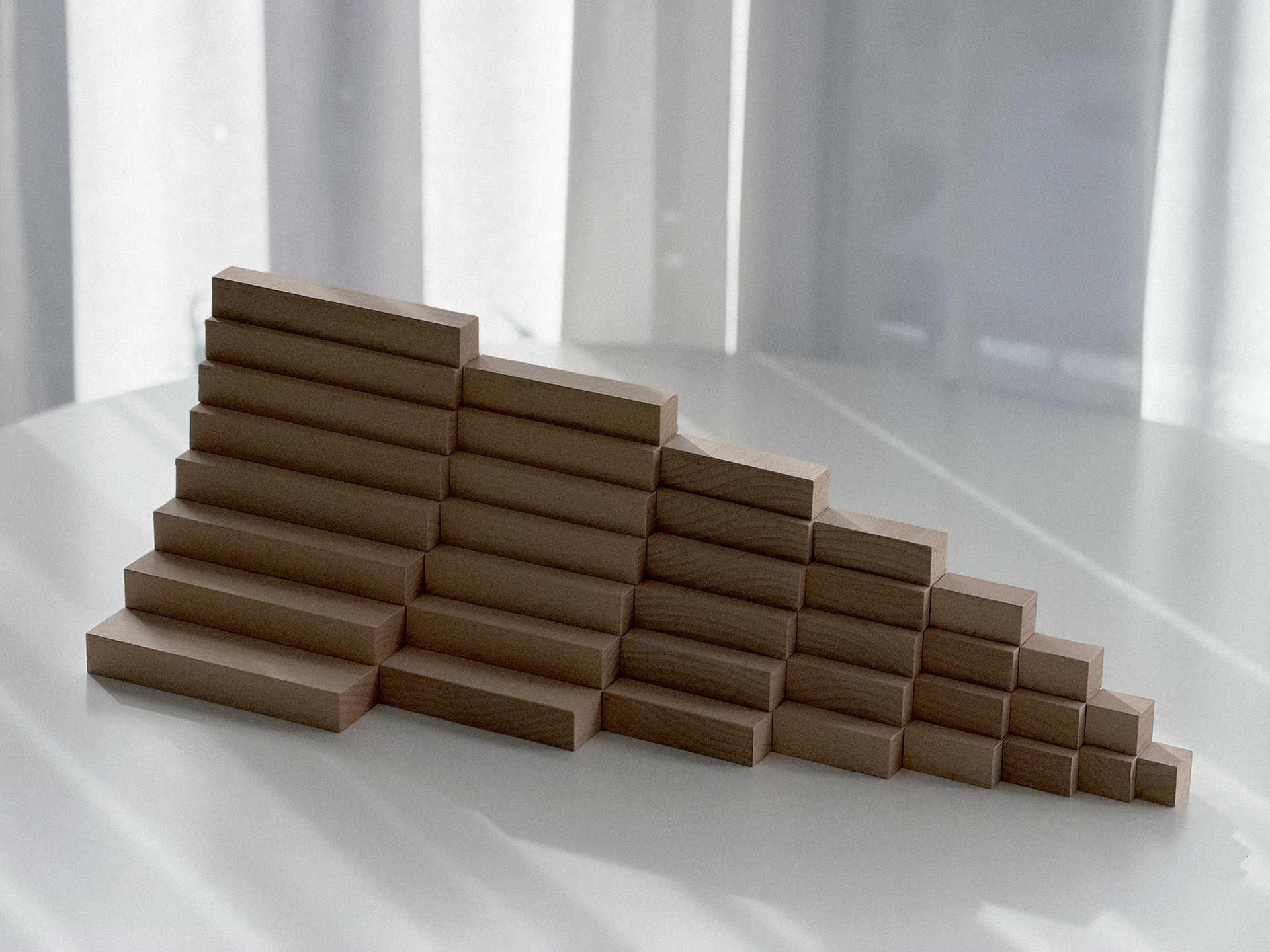
Each measure following the next according to the ground proportion of 3 to 4, forming a gradual progression of clearly distinguishable sizes.
Playing with Order
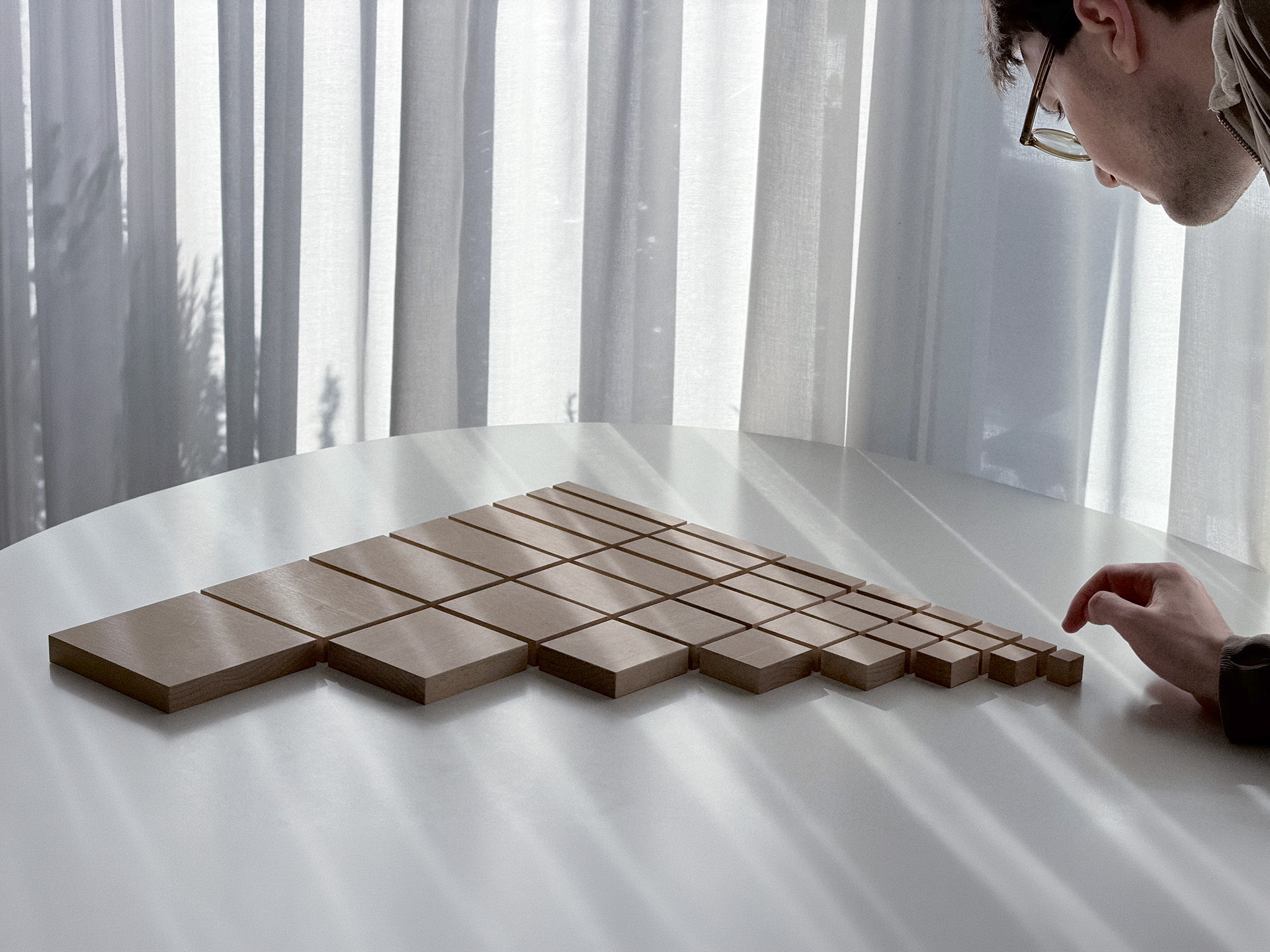
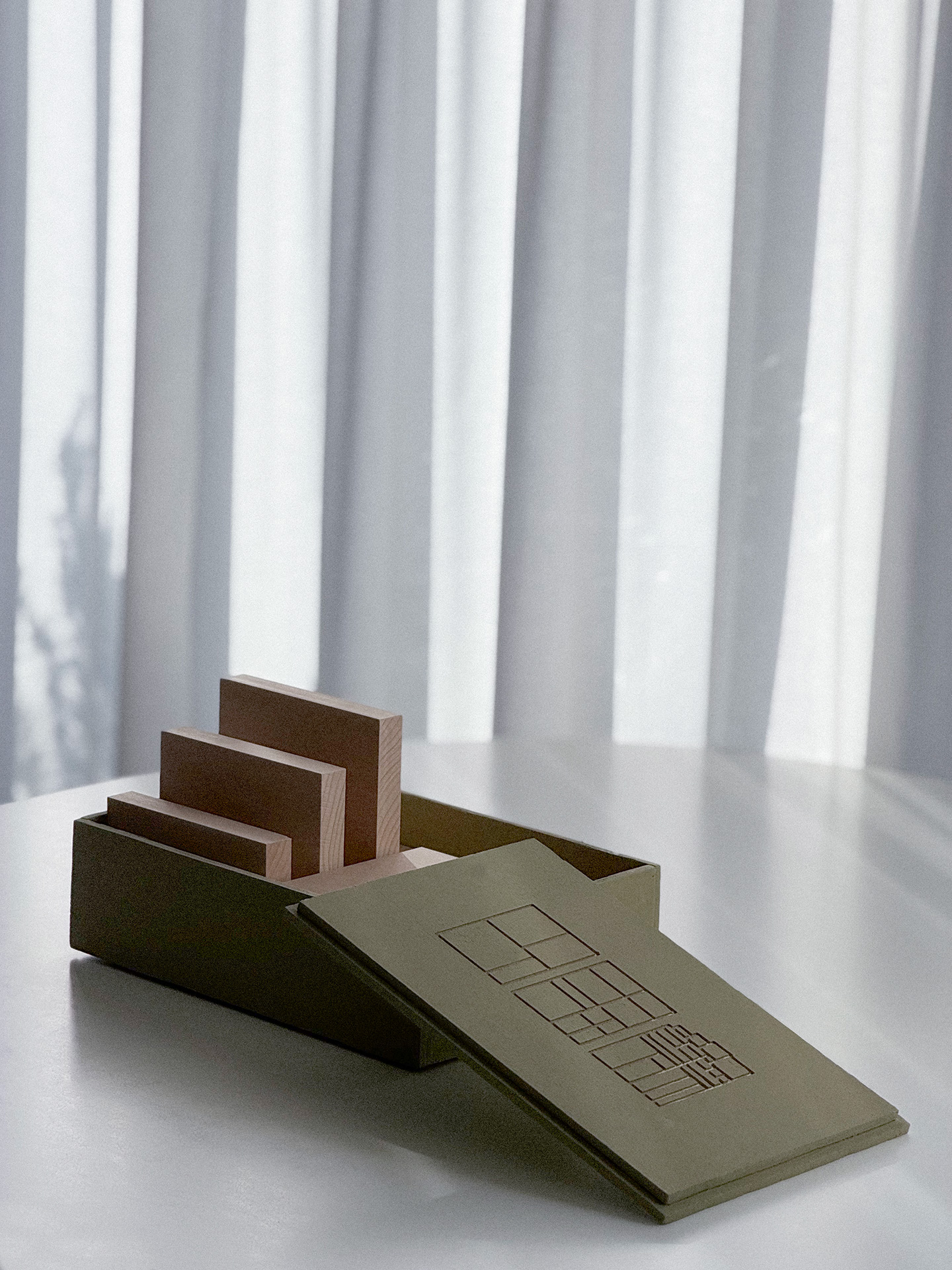
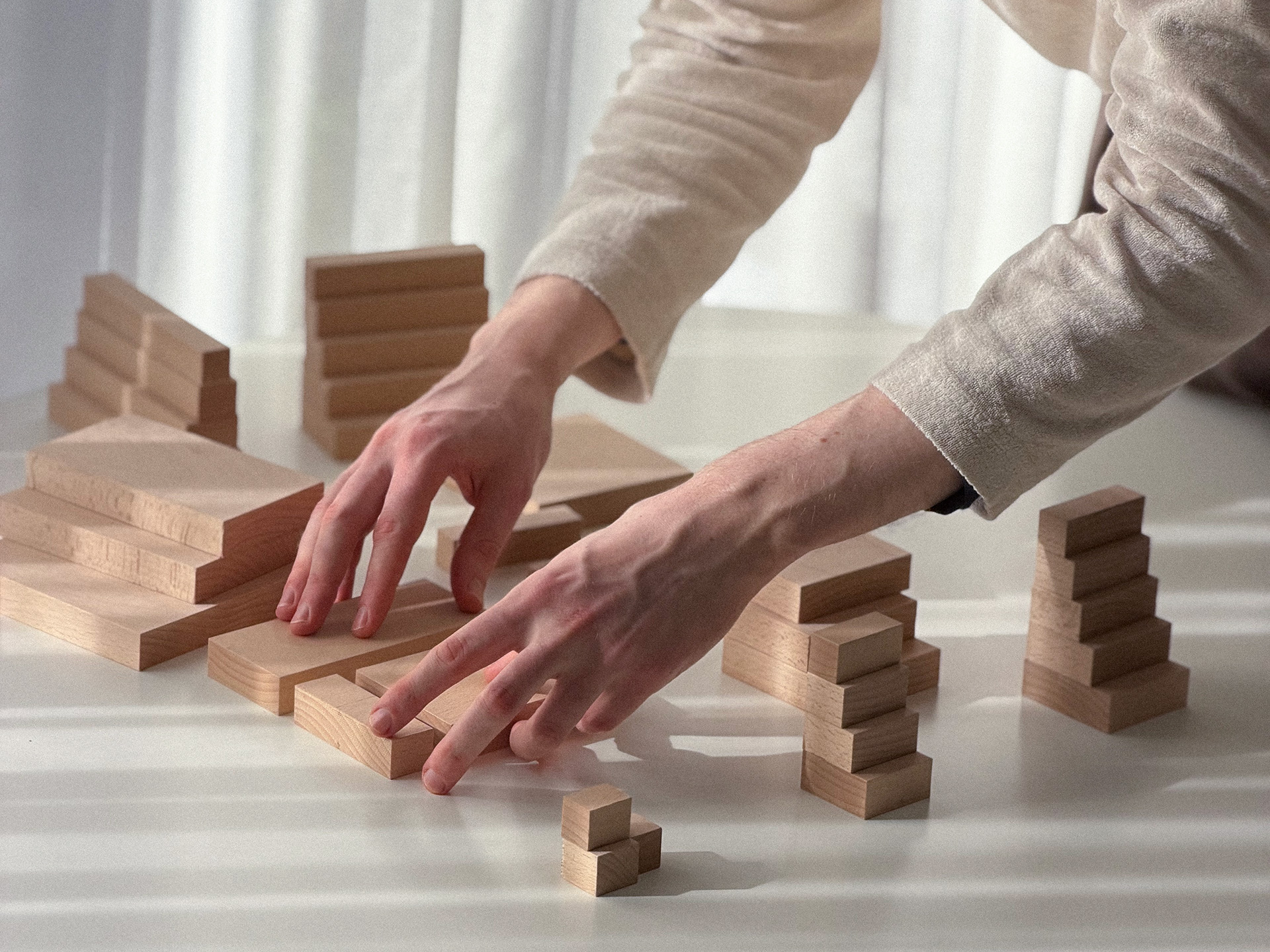
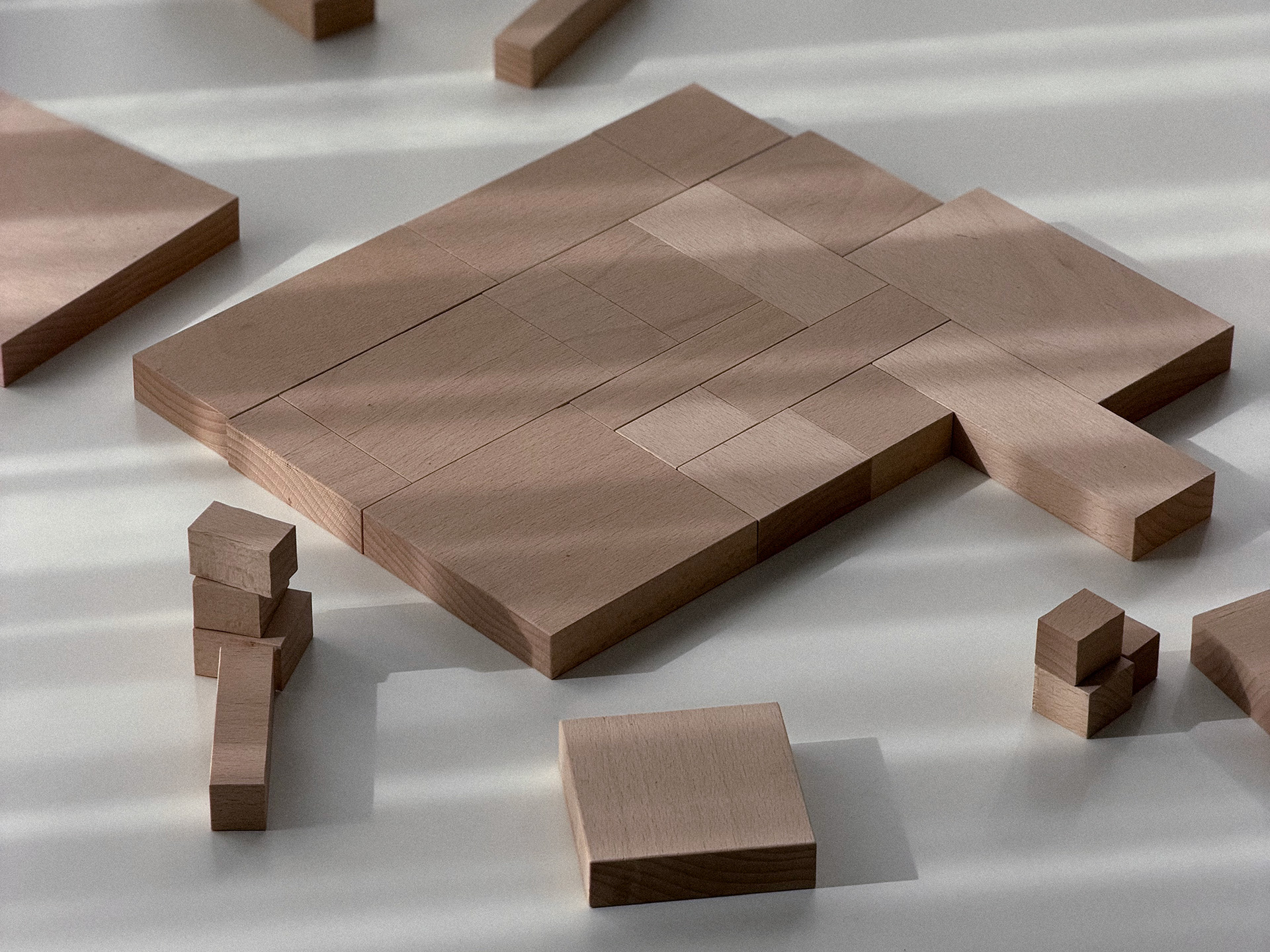
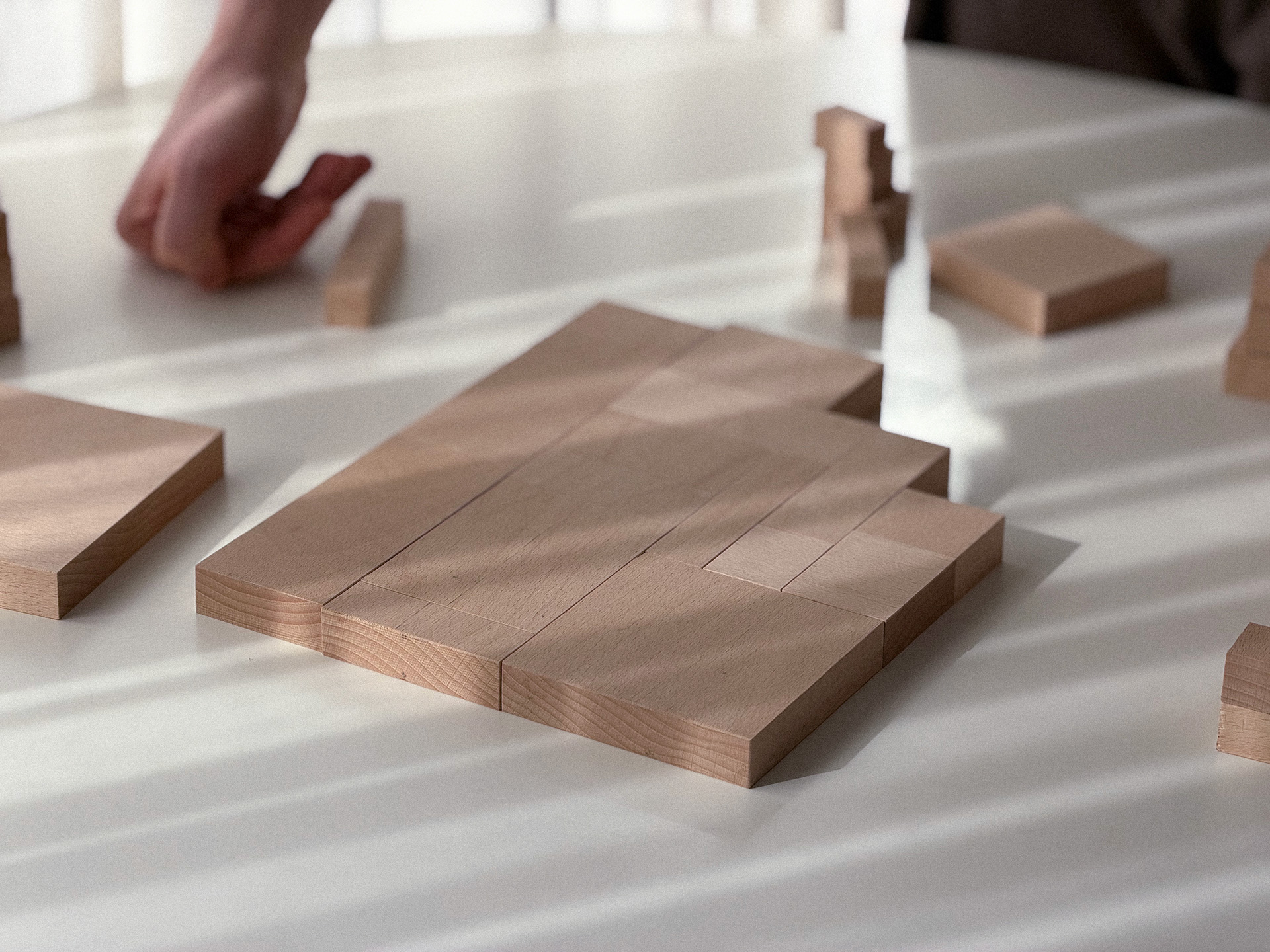
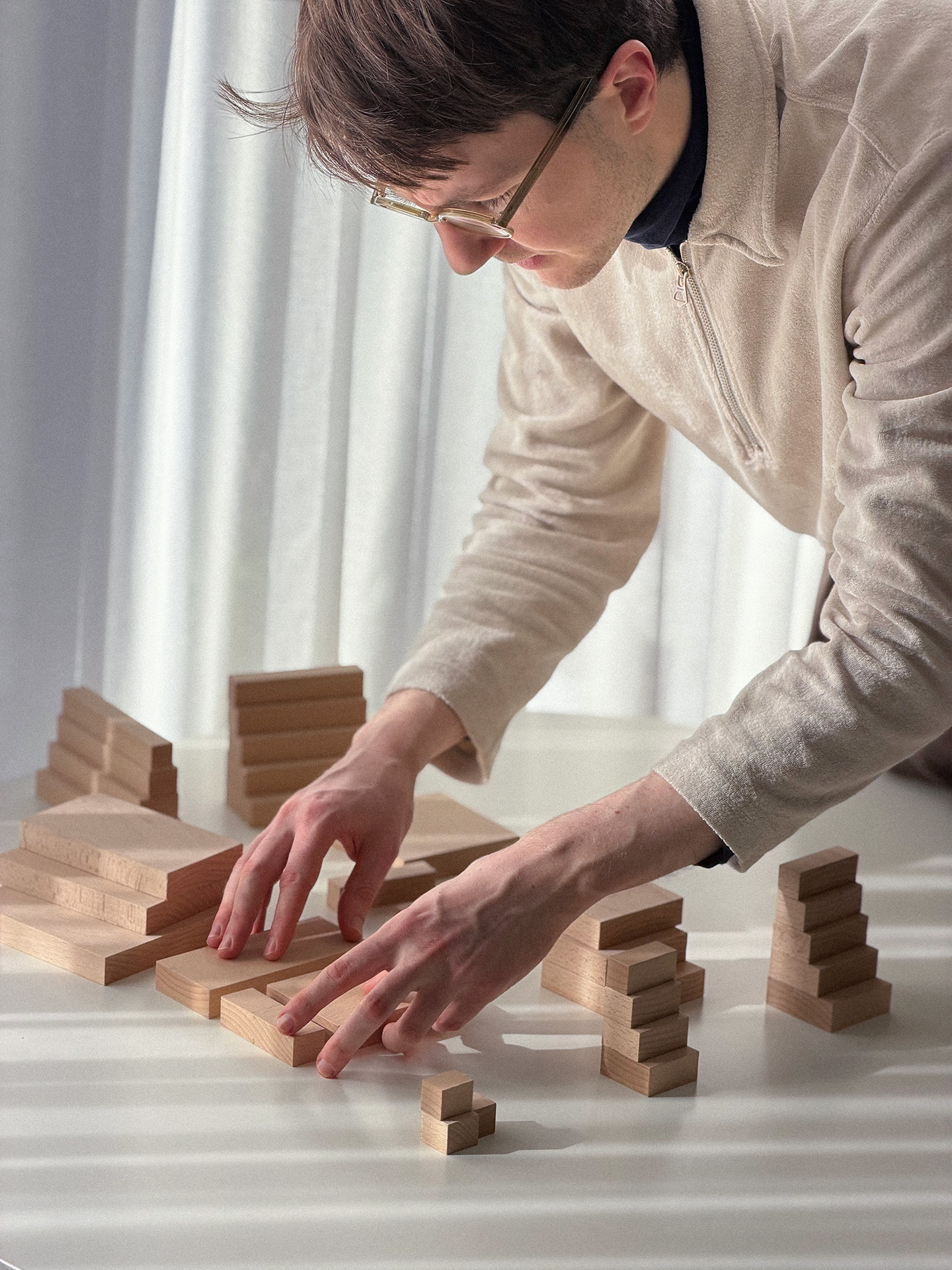
This is where the morphotheque comes in, developed by Van der Laan. A morphotheque is a set of simple volumetric blocks, each differing slightly in size, arranged in a gradual sequence. At first glance, they are nothing more than rectangular solids. But their purpose is not representation. It is interaction. They are meant to be held, moved, compared, arranged.
By handling these blocks, differences begin to appear. Some feel close in size, others clearly distinct. Some combinations feel balanced, others less so. In their relationships, they begin to resonate, almost like a spatial melody. As on a piano, where pressing one key allows certain others to sound in harmony within the same octave, these forms relate in a way that feels ordered. Without measuring, without naming, a sense of proportion starts to emerge. This process is not analytical. It is experiential. Through repetition, you begin to build an intuitive understanding of scale, relation, and order. To compare is to begin to understand relationships. And through relationships, a sense of structure appears.
Proportion is not an abstract idea. It plays a crucial role in how we perceive and navigate the world. The relationships between sizes help us judge distance, understand function, and recognize coherence in what we see around us. Van der Laan described architecture as something that mediates between us and nature. Nature is continuous, immeasurable in its variation. Architecture introduces order, kosmos, an order that makes the world intelligible to us.
Any artifact we make serves both body and spirit. It answers a need, but it also carries meaning. The constraints of making, material, technique, and use are accompanied by something else: a search for clarity. For a form that not only works, but can be understood. In that sense, what we make reflects something of ourselves. The union of what satisfies the body and what satisfies the spirit.
Holding a Block
Kees den Biesen, who lived and worked alongside Van der Laan in the monastery, returned to his room one day after his work in the library and heard the sound of sanding through the wall. He went in to say hello. There he found him, holding a block and quietly looking at it. “Only if you hold each of these blocks like a little baby, cradle it in your hand, feel its weight, explore its edges and surfaces, will you really get to know it.”
Maybe that is all I hope for. That these objects will be held. Explored. Turned over in small hands. And that, through them, a way of seeing the world begins.
Sources
Dom Hans van der Laan, De Architectonische Ruimte (1977). Brill, Leiden.
Tiziana Proietti and Kees den Biesen (eds.), Hans van der Laan’s Instruments of Thought: Proportion, Architecture and Analogy (2025). Routledge.
Caroline Voet, Dom Hans van der Laan in Practice: A Design Manual (2025). nai010 Publishers.
Roosenberg - Waasmunster | 9 brieven van de architect (2008). Herdruk Abdij Sint Benedictusberg - Vaals.
C.M. Howell, Hans van der Laan’s Instruments of Thought: Proportion, Architecture, Analogy (2025). Drawing Matter.
Fabrication
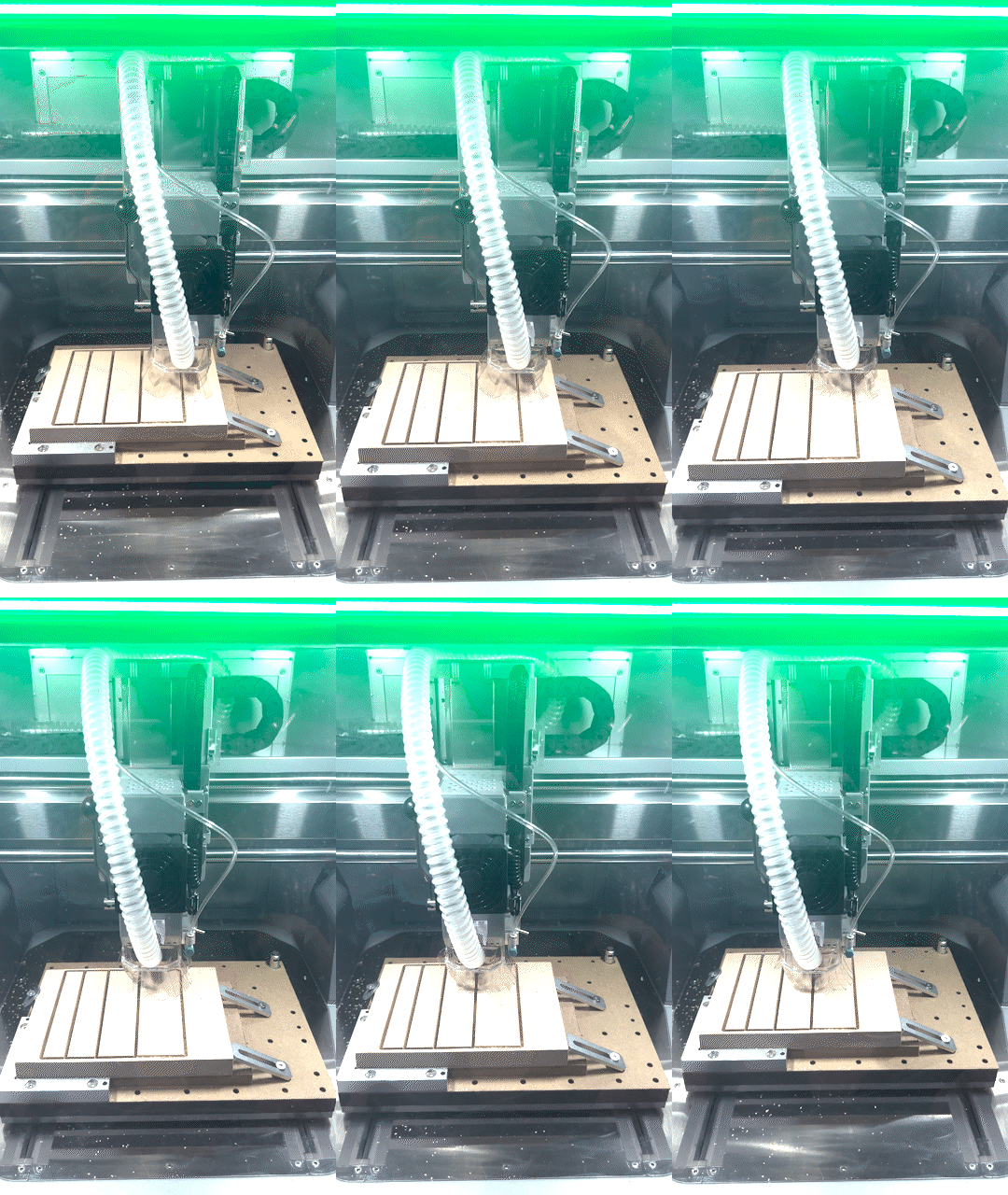
CNC milled from solid birch wood.
Photography
Yahui Wang